

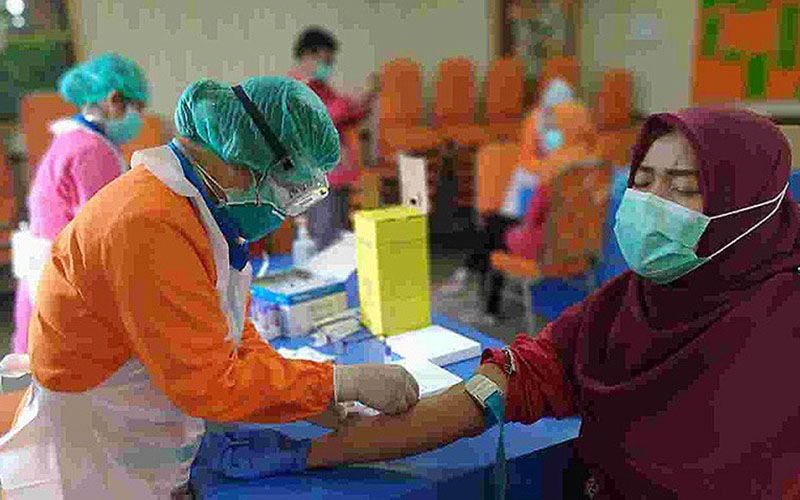

You may have heard about how more and more people are undergoing what is called a rapid PCR coronavirus test, one that can be analyzed quickly at a doctor’s office or clinic, with results available in as little as a few minutes. This could be something of a game changer for employers.
Similarly, Whats PCR stand for?
PCR (polymerase chain reaction) tests are a fast, highly accurate way to diagnose certain infectious diseases and genetic changes. The tests work by finding the DNA or RNA of a pathogen (disease-causing organism) or abnormal cells in a sample.
Is PCR better than Rapid? In fact, if you have ever been asked to show proof of a COVID-19 test, you were required to provide results from a PCR test. These tests provide more accurate results than rapid tests, and that’s because they use a polymerase chain reaction (PCR) to identify the viral genetic material of COVID-19.
Thereof, What is the difference between PCR and antigen testing?
An antigen test is a rapid test, while the PCR test traditionally takes a few days to return results. An antigen test looks for specific proteins found on the surface of the virus, while a PCR test seeks out and amplifies the presence of the virus’s DNA material.
What is difference between RT-PCR and rapid test?
Although it is less sensitive than the RT-PCR test, the antigen test is an effective way to monitor infection in people who are in close contact with COVID-19 infected. Rapid antigen tests are often used as mass screening tests to detect SARS-CoV-2 infection quickly in containment zones or healthcare settings.
Is PCR test accurate?
RT-PCR tests are very accurate when properly performed by a health care professional, but the rapid test can miss some cases. Antigen test. This COVID-19 test detects certain proteins in the virus.
How long do you test positive after Covid?
If you get COVID-19, you may test positive on a PCR test for several weeks after you have ceased to be infectious. With a rapid test, you may test positive for six or seven days after your symptoms have cleared.
When should I get a PCR test?
You should get tested in the first 3 days of symptoms appearing, although testing is effective until day 5. You should not book a PCR test if you have tested positive for coronavirus in the last 90 days, unless you develop new symptoms.
Will you test positive after having Covid?
Unfortunately, many people can test positive for COVID-19 for weeks or even months, but there is good news: people are not likely to be contagious for that long, even if they test positive, and therefore are unlikely to transmit the virus to others.
How long is Covid positive after recovery?
Recovered patients: Patients who have recovered from COVID-19 can continue to have detectable SARS-CoV-2 RNA in upper respiratory specimens for up to 3 months after illness onset. However, replication-competent virus has not been reliably recovered from such patients, and they are not likely infectious.
How accurate is PCR Covid test?
RT-PCR tests are very accurate when properly performed by a health care professional, but the rapid test can miss some cases. Antigen test. This COVID-19 test detects certain proteins in the virus. Using a long nasal swab to get a fluid sample, some antigen tests can produce results in minutes.
How accurate is the PCR Covid test?
RT-PCR tests are very accurate when properly performed by a health care professional, but the rapid test can miss some cases. Antigen test. This COVID-19 test detects certain proteins in the virus. Using a long nasal swab to get a fluid sample, some antigen tests can produce results in minutes.
How accurate is an antigen test for Covid?
Antigen tests
This is likely to be because people have the most virus in their system in the first days after they are infected. In people who did not have COVID-19, antigen tests correctly ruled out infection in 99.5% of people with symptoms and 98.9% of people without symptoms.
Is PCR an antigen or antibody test?
While antigen tests look for proteins on the surface of the virus to ascertain the presence of the pathogen, PCR (polymerase chain reaction) tests are engineered to seek genetic material called RNA that instructs the virus to make these proteins.
Is PCR more accurate than antigen?
Rapid, accurate tests are essential to contain a highly contagious virus like SARS-CoV-2. PCR tests are accurate but can take a long time to produce results. Antigen tests, the other major type of coronavirus test, while much faster, are less accurate.
Why is a PCR test more accurate?
Because the PCR test is so sensitive, it can detect very small amounts of virus material. This means that the test can continue to detect fragments of SARS-CoV-2 virus even after you’ve recovered from COVID-19 and are no longer contagious.
Which is better ELISA or PCR?
Compared to ELISA, real-time PCR showed greater agreement among duplicate samples. ELISA was found to be less time consuming and easier to perform than real-time PCR. ELISA and real-time PCR showed 100% specificity during reference sample testing.
What is PCR negative?
If your PCR test is negative, you’ll get a text message to say that the test did not detect COVID-19. This means that the virus was not found in your sample. A negative PCR test result does not mean that you’ve never had COVID-19.
Are you still contagious after 10 days of COVID?
Available data suggest that patients with mild-to-moderate COVID-19 remain infectious no longer than 10 days after symptom onset.
Can Covid come back?
Reinfection with the virus that causes COVID-19 means a person was infected, recovered, and then later became infected again. After recovering from COVID-19, most individuals will have some protection from repeat infections. However, reinfections do occur after COVID-19.
How long does Covid stay in the air indoors?
Transmission of COVID-19 from inhalation of virus in the air can occur at distances greater than six feet. Particles from an infected person can move throughout an entire room or indoor space. The particles can also linger in the air after a person has left the room – they can remain airborne for hours in some cases.
Join TheMoney.co community and don’t forget to share this post !

